ACOUSTIC TREATMENT METHODS FOR RECORDING STUDIOS
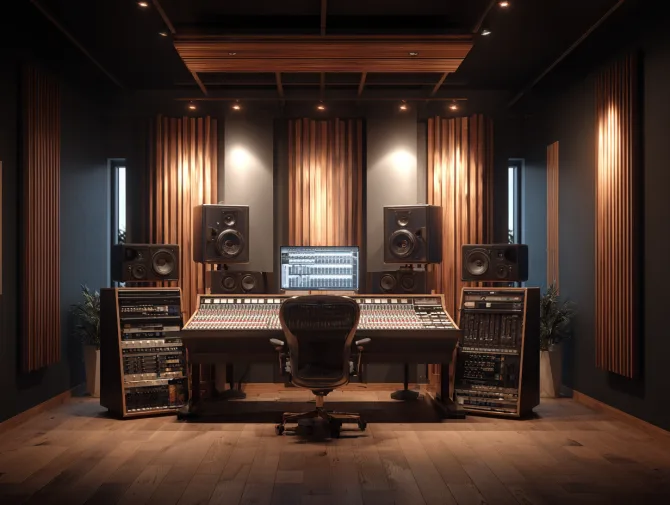
Acoustic treatment in a recording studio addresses three tasks: absorbing excess reflections to reduce reverberation time, scattering sound waves to prevent flutter echo, and controlling low-frequency buildup in room corners. A properly treated studio achieves RT60 of 0.3–0.5 seconds and an even frequency response across the recording space. Without acoustic treatment, even a well-isolated studio will produce recordings colored by room resonances and reflections.
Absorption Panels
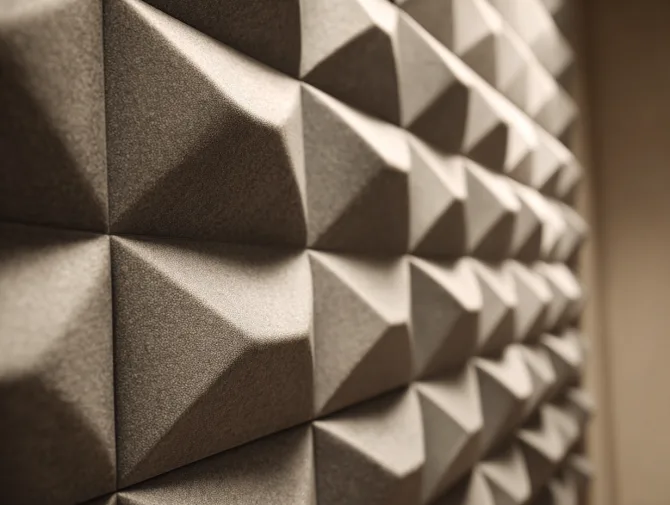
Absorption panels are constructed from porous materials — open-cell foam, fiberglass, or mineral wool — that convert sound energy to heat as air molecules move through the material under acoustic pressure. They are effective primarily in the mid and high frequency range.
The lower frequency limit of an absorption panel is determined by its thickness. A 2-inch foam or fiberglass panel is effective from approximately 500 Hz upward. A 4-inch panel absorbs effectively from approximately 250 Hz. Below 250 Hz, standard absorption panels have a negligible effect, and low-frequency control requires dedicated bass traps.
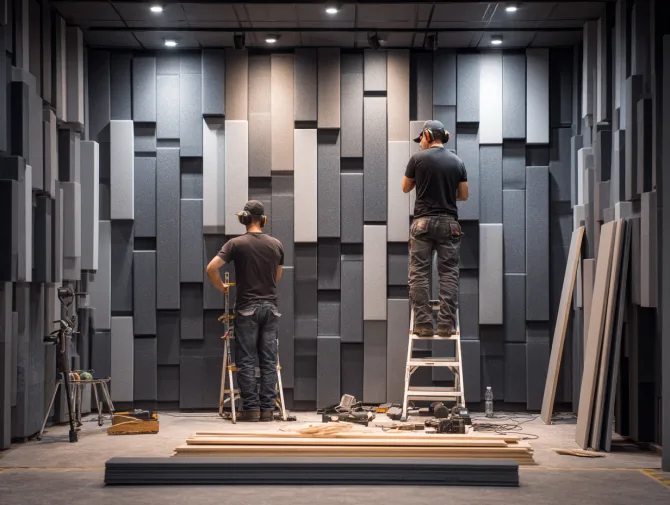
Absorption panels are placed at first reflection points — the locations on walls, ceiling, and floor where sound from the monitor speakers reaches after a single reflection before arriving at the mix position. On the side walls, this is approximately halfway between the monitors and the listening position. On the ceiling, it is the point directly above the listening position. Treating first reflection points reduces comb filtering at the mix position, improving frequency response accuracy.
Bass Traps
Bass traps are thick, dense absorbers designed specifically for the low-frequency range of 63–250 Hz. They are installed in room corners — the intersections of two walls, or a wall and the ceiling or floor.
Corner placement is the most effective position for bass traps because low-frequency pressure builds up at structural boundaries. At the point where two walls meet, pressure is twice the room's average. At the tri-corner where two walls and a ceiling or floor intersect, pressure is approximately eight times the room average. Installing bass traps floor-to-ceiling in all four vertical room corners and at the ceiling-wall junctions targets the zones where low-frequency energy concentrates most heavily.
Without bass traps, low-frequency room modes — resonances at frequencies related to the room dimensions — cause certain bass notes to appear louder or quieter than others at the mix position. This makes accurate bass mixing impossible, and recordings made in such rooms will have uneven low-end when played back on neutral systems.
Diffusion Panels
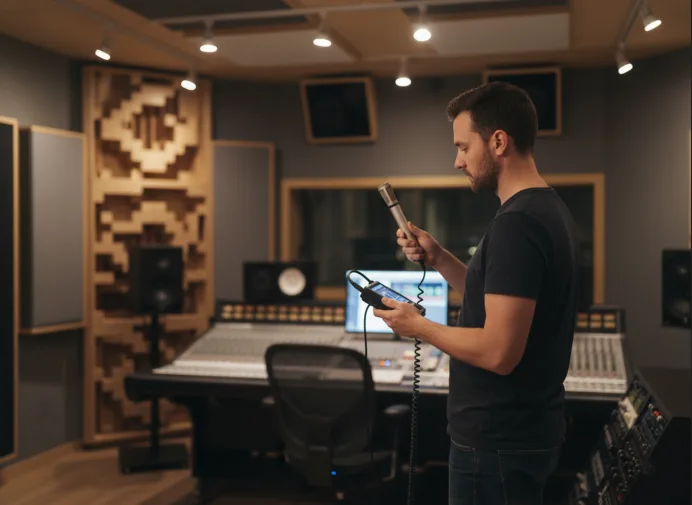
Diffusion panels scatter incoming sound waves in multiple directions rather than absorbing them. They are used on the rear wall of a recording studio — behind the listening position — to prevent focused reflections returning directly from the back wall to the mix position.
The practical difference between absorption and diffusion is the acoustic character of the treated space. Absorption removes reflections entirely, reducing reverberation time. Diffusion spreads reflections in time and direction, maintaining a sense of acoustic space while eliminating direct echoes. A studio treated entirely with absorption becomes acoustically "dead\" — recordings made in it lack natural ambience and feel unnaturally compressed. The standard approach is absorption at first reflection points combined with diffusion at the rear wall, producing a front-dead, rear-diffuse acoustic environment appropriate for mixing and tracking.